

Most men don’t walk into a therapist’s office and say, “I think I have an attachment problem.” They come in because their wife says they’re checked out. Because they can’t seem to stop picking fights. Because something about their marriage feels distant or exhausting and they don’t know why.
What they’re often describing — without knowing it — is an attachment pattern. And understanding it might be the most useful thing you do for your relationship.
What Is Attachment, Actually?
Attachment is how you seek safety and closeness in relationships when you’re under stress.
It’s not a personality trait. Not a diagnosis. A strategy — one your nervous system developed early in life and has been running in the background ever since. Like an operating system on your phone: when it’s working, you don’t notice it. When it starts glitching, everything feels harder than it should.
Your attachment pattern was largely formed in your first year of life through repeated interactions with your primary caregiver. When a child is consistently seen, soothed, responded to, and repaired with after ruptures, the nervous system learns a foundational truth:
My needs will be reliably met. The world is safe. People can be trusted.
When those things don’t happen consistently — not because parents are bad people, but because they were unavailable, preoccupied, or inconsistent — the nervous system learns something different. And it develops a strategy to cope.
Two of the most common strategies look like this:
The Guy Who Disappears — Avoidant Attachment
Some men learned early that reaching out didn’t work. They needed comfort or connection, and what came back was dismissal, silence, or something that made things worse. So at some point — not consciously, the brain just did this — they stopped reaching.
I’ll manage on my own. I don’t need much. I’m fine.
This didn’t feel like a decision. It just became true.
In adulthood, avoidant attachment tends to look like:
- Greater comfort with distance than closeness
- The ability to enjoy relationships without feeling like you need them
- A tendency to live in your head — analytical, cerebral — partly because thinking is safer than feeling
- Difficulty recalling emotionally connected memories from childhood, even when facts come easily
- A tendency to say things like “the past is the past” or “I turned out fine”
- A partner who describes you as checked out, emotionally unavailable, or hard to reach
The avoidant man isn’t cold. He’s not broken. He learned that self-reliance was the safest bet — and that philosophy made sense at the time. The problem is that the strategy that protected him as a child is now keeping distance between him and the people he loves most.
The Guy Who Can’t Let Go — Ambivalent Attachment
Other men learned something different. Their caregiver was inconsistent — sometimes warm and responsive, sometimes preoccupied or unavailable. Never quite predictable. So the nervous system concluded:
I have to reach harder. I have to be louder. Unless I make it really obvious that I’m hurting, no one is going to come.
In adulthood, ambivalent (or anxious) attachment tends to look like:
- Anger that seems disproportionate to the situation
- A strong need for reassurance from a partner
- Pushing harder when a partner pulls away
- Getting labeled controlling, needy, or too intense
- A deep, underlying fear that the people you love are going to leave
This man often looks like he has an anger problem. He doesn’t. He has a nervous system that never got a consistent answer to the question: are you going to be there for me?
What Happens When These Patterns Meet
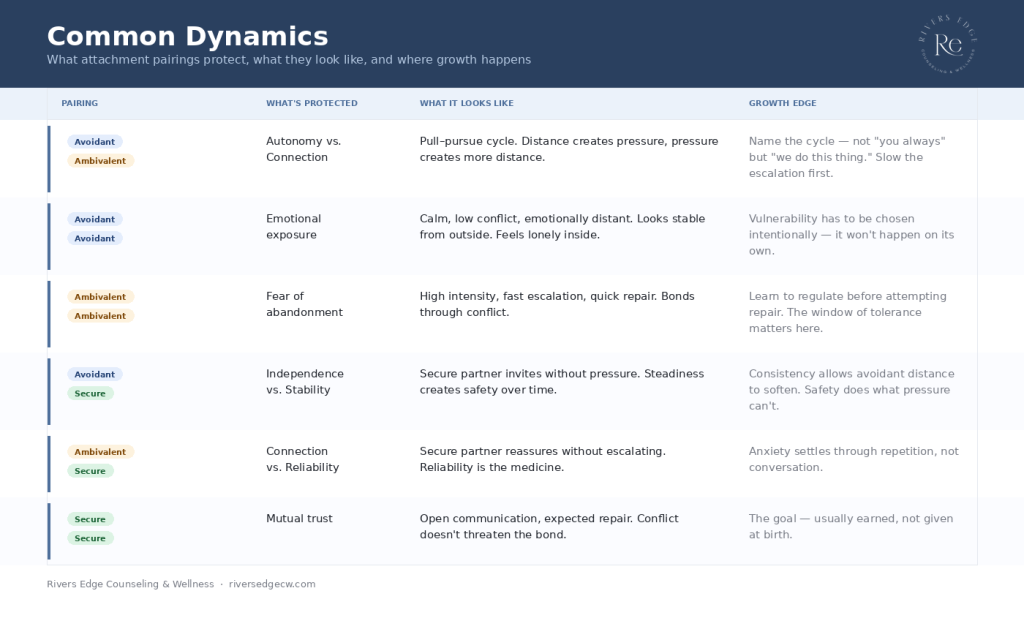
Most couples contain at least one of these patterns — and often both. The image below shows what the most common pairings tend to look like, and where the growth edge is for each.
The Good News: Attachment Isn’t Fixed
Here’s what most people don’t know: attachment patterns can change. They’re not your destiny. They’re a first draft — written before you had any say in the matter — but drafts can be revised.
What changes attachment isn’t insight alone. You can understand your pattern perfectly and still respond the same way when your chest tightens and your thoughts race during a conflict. Understanding is not reprogramming.
What actually rewires the nervous system is repeated relational experience — specifically, repeated rupture and repair. Trust isn’t built through perfection. It’s built through the consistent willingness to come back, own what happened, and reconnect.
That was me. I’m sorry. I’m still here. Over and over.
This is what researchers call earned secure attachment — security that wasn’t given in childhood but has been built through the accumulated experience of a relationship where repair is expected and practiced.
Small, consistent movements matter more than dramatic breakthroughs. Showing up the same way enough times that your partner’s nervous system starts to believe you — that’s the work.
Six Practices for Moving Toward Security
Here are six concrete practices for moving toward earned secure attachment in your relationship:
- Attunement — Be curious about your partner without judgment. Ask questions. Try to understand their inner world before responding to their behavior.
- Responsiveness — Connect before you redirect. When your partner is distressed, the first move is toward them, not toward fixing the problem.
- Engagement — Stay present in difficult moments instead of shutting down or walking away. Physical presence without emotional presence isn’t enough.
- Regulate first — Learn to self-soothe before re-engaging in conflict. Walk, breathe, pray — find what brings you back before attempting repair.
- Hold the hard emotions — When your partner expresses anger, sadness, or fear, practice staying present without collapsing, defending, or escalating.
- Repair — Own your part. Say so. Reconnect. Repair doesn’t have to be elaborate — it has to be honest and consistent.
A Question Worth Sitting With
If any of this resonated — or if you’ve been reading this wondering whether you recognize yourself in one of these patterns — here’s the question to take with you:
What have you been doing to feel safe — and what has it been costing you?
Just sit with it.
Ready to Go Deeper?
Understanding your attachment pattern is one thing. Doing something about it — especially when old wiring keeps firing — is often best done with support.
At Rivers Edge Counseling & Wellness, we work with men, couples, and families using attachment-informed, faith-integrated approaches. Our team is here to help you move from the patterns that have been running in the background toward the kind of presence your relationships are asking for.
Tyler Sullins is a Licensed Professional Counselor-Supervisor (LPC-S #71869) and owner of Rivers Edge Counseling & Wellness in Boerne, Texas. He works with individuals and couples on issues of attachment, identity, relationship, and faith.